Plastic is never a single material. The polymer, pigments, fillers, fibers, finish, geometry and intended reading method all influence the contrast, appearance and repeatability of laser marking.
ENGINEERING PLASTICSUV MOPAmaterial, contrast and readability
GRADERESULTREADABILITY
REAL PART FIRST
01
THE STARTING POINT
The polymer alone is not enough.
A designation such as PA, POM, PBT, PEEK, PC or ABS does not yet describe how the part will respond to the laser. The formulation, color, fillers, fibers, additives, surface condition and thickness are all part of the application to be qualified.
FIVE KEY POINTS
From material to useful readability.
A traceability project on plastic links the material grade to a concrete need: text, serial number, 2D code, logo or variable data. This combination guides the test and the choice of laser source.
NWS LASER case: the same composite family may need to be validated for each color.01
Identify the actual grade
Material reference, color, fibers, mineral fillers, flame retardants and finish change how the beam interacts with the material. A representative sample is more useful than a generic polymer designation.
The 355 nm UV laser should be considered when surface interaction and fine detail are central. A MOPA fiber laser provides a range of pulse, pulse repetition rate and energy settings at 1064 nm. No laser source replaces material testing.
03
Define the acceptable result
Contrast, color, roughness, possible surface melting, clean edges and preservation of appearance are product criteria. They must be defined before seeking the maximum production rate.
For a 2D code, the data to be encoded determines the modules, quiet zone and usable space. The guide Sizing a DataMatrix for laser marking helps establish these assumptions.
05
Plan for the actual cycle
The fixture, geometry, height, orientation, scanning, extraction, throughput and reader all contribute to the production result. They must be validated with the actual part and production flow, not just from a photograph.
SOURCES TO INVESTIGATE
UV, MOPA, or a comparative test.
SourcePhysical principleSituations to investigatePoint to watchUseful validation
UV 355 nmSurface interaction to be qualifiedSensitive parts, fine information, composites, surfaces where appearance mattersContrast, surface integrity, precision and durability depending on gradeTest on each representative part Explore UV technology
MOPA fiber 1064 nmAdjustable pulse duration, repetition rate and energyCertain formulations markable in the near infrared; need for an extended range of contrast or cycle adjustmentsAppearance, localized heating, melting or color change depending on compoundParameter testing on the actual formulation See MOPA settings
Comparison on the partThe material response is decisiveNew project, multi-color range, critical finish, dense code or cycle-time requirementDo not choose the source based solely on the polymer nameShared material, appearance, reading and throughput protocol
These reference points do not constitute a settings table. Wavelength, focusing, pulse duration, energy, repetition rate and scanning strategy are defined using a representative part.
TEXT, LOGO OR 2D CODE
Contrast alone is not enough for readability.
A marking can look clean and still be unreliable at the inspection station. For a DataMatrix, the content, modules, lighting, reader and part presentation are interrelated.
01
Start with the exact data
A part number, serial number, lot or variable content do not require the same capacity. Avoiding unnecessary fields can preserve module size and available space.
02
Reserve the right area
The usable area takes into account the part geometry, edges, radii, raised features and the space around the symbol. Use the DataMatrix preliminary sizing tool to make the assumptions visible before testing.
03
Validate with the intended reader
An enlarged image does not reproduce the production camera or reader. Distance, lighting, movement, depth of field and orientation should be made as close as possible to actual conditions.
These use cases illustrate different parts, appearances and levels of detail. They do not replace testing on your grade and finish.
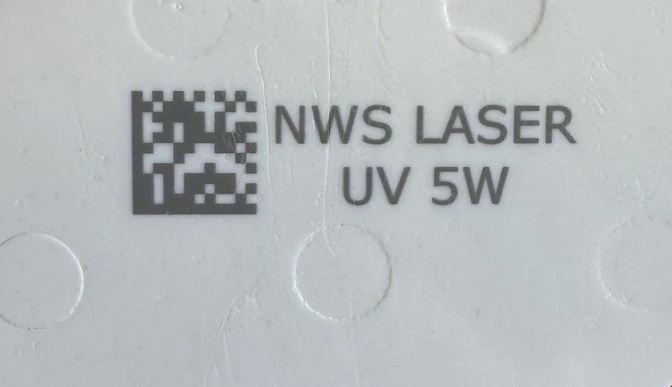
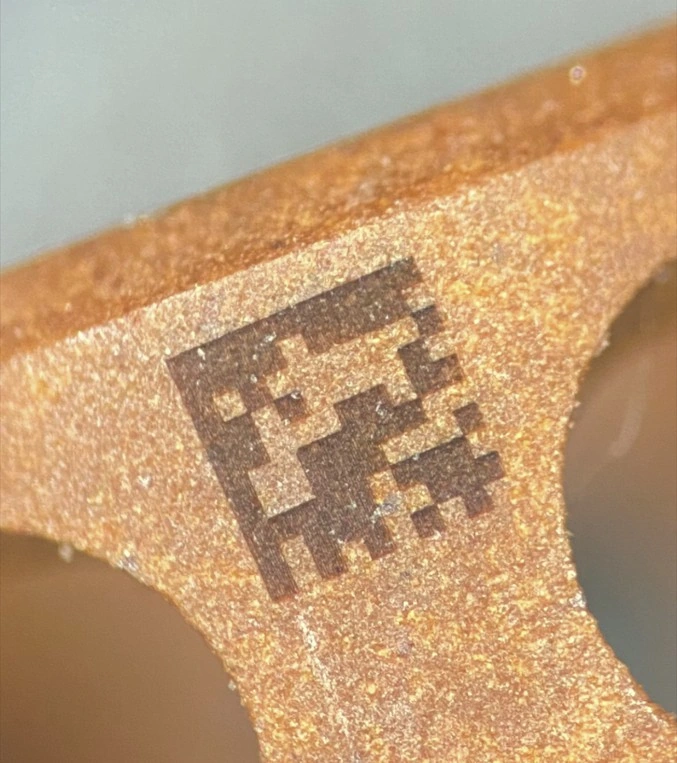
UV on composite: pigments, fillers, colors and surface condition may require validation for each material reference.Plastic card: information content, fine detail and surface appearance must be considered together.0,4 × 0,4 mm Micro-DataMatrix on composite: fixturing, modules and rereading are all part of the project.
TEST PROTOCOL
From material grade to the usable cycle.
StepProject inputsWhat the test verifiesDecision to makeExpected output
SurveyGrade, color, fillers, finish and samplesVariants actually present in the product rangeReferences to include in the testRepresentative sample set
MarkText, logo, code, area and expected appearanceContrast, detail, edges and surface interactionProcess and settings to investigate furtherComparable test series
ReadExact data, reader or camera and environmentDecoding and repeatability under the intended conditionsModule, contrast and reading strategyUsable reading results
IntegrateFixture, cycle, handling, extraction and management of deviationsCompatibility with the production flowWorkstation or line architectureIntegration orientation
Durability, appearance and readability criteria must be defined by the project and, if necessary, by the specifications applicable to the final product.
FREQUENTLY ASKED QUESTIONS
Before finalizing a plastics process.
Can all engineering plastics be laser marked?
The result depends on the polymer or compound, its pigments, fillers, fibers, additives and surface condition. Qualification using the grade and color actually being produced is necessary.
Should you choose a UV laser or a MOPA fiber laser?
The choice depends on the desired interaction, material, level of detail, contrast, acceptable surface appearance and throughput. MOPA broadens the range of settings for a 1064 nm fiber laser; 355 nm UV addresses different types of surface interaction.
Does a clear DataMatrix in a photo mean it is validated?
No. The content, module size, available area, contrast, lighting, positioning and intended reader or camera must be qualified together.
Does each color need to be validated?
When pigments, formulation or finish change, the response to the laser may change. Testing determines whether one common recipe is sufficient or whether separate settings are needed.
What information should be provided for a test?
The material grade or compound reference, colors, finish, representative samples, area to be marked, data to be inscribed, throughput and intended reading method help prepare a useful test.
ENGINEERING PLASTICS STUDY
Send us the material grade to qualify the part.
Provide the material or compound reference, colors, samples, finish, area to be marked, content, throughput and intended reading method. NWS LASER will provide process guidance rather than a generic promise.
PROJECT CALLBACK
Let’s arrange your callback.
Leave your contact details: an NWS Laser representative will get back to you to position your project and the next useful step.
REQUEST SENT
Thank you. Your form has been submitted.
The NWS Laser team has received your inquiry and will contact you shortly.