Define the code content
The data to encode determines the number of modules. At a fixed size, more modules mean smaller modules. Useful data and reading capabilities must be defined together.
DIRECT TRACEABILITY · UV 5 W LASER
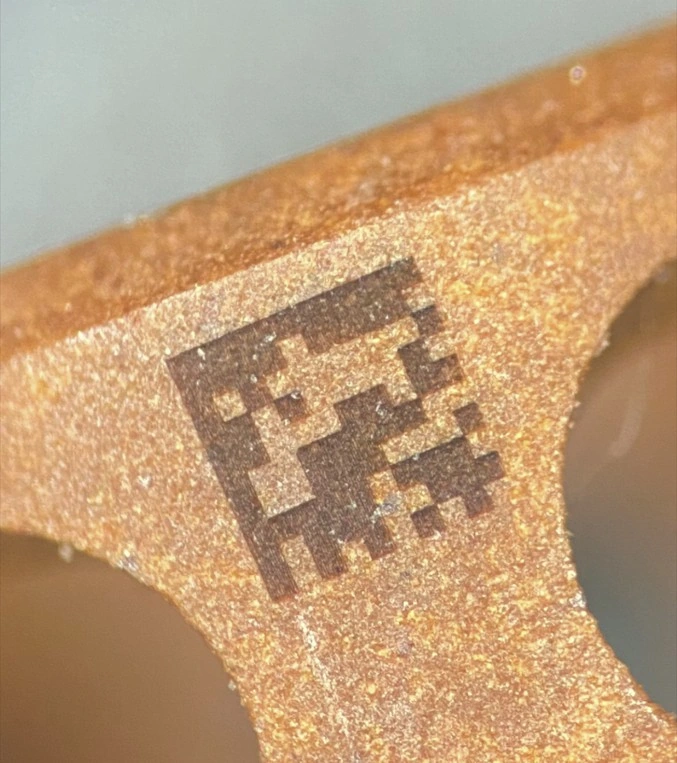
A Micro-DataMatrix 0.4 × 0.4 mm marked directly on a miniature ball bearing cage made of composite material, using a UV 5 W laser.
This application places a Micro-DataMatrix 0.4 × 0.4 mm on a miniature ball bearing cage made of composite material. The code concentrates information in a very small area, directly on the part.
Marking is performed with a UV 5 W laser source. For this miniature format and the cage geometry, part fixturing and the definition of the code modules require particular care. Parameters must be qualified on the actual composite material.
A TINY CODE, AN APPLICATION TO QUALIFY
The data to encode determines the number of modules. At a fixed size, more modules mean smaller modules. Useful data and reading capabilities must be defined together.
Fixturing must stabilise the cage and present the marking area repeatably. UV laser parameters are adjusted on the actual composite, its surface condition and the desired contrast.
Readability must be verified with the intended camera or reader, its lighting and the real positioning of the cage. A photo of the code does not replace validation under production conditions.
On a view of the cage, indicate the proposed face and a reference point that allows its orientation to be found. Distinguish the suggested area from surfaces whose function imposes specific requirements. Which areas must remain excluded from marking? The distances to be maintained and any restrictions need to be agreed during the study.
Specify at which stage the cage would be marked and then read: as a separate part or incorporated into the bearing. Would the area remain accessible at both stages? An overall view and a close-up view with reference points allow this question to be presented without assuming that the illustrated configuration suits your part.
Prepare a string representative of the identifier to be encoded, together with the expected result when read. If some data change from one cage to another, distinguish fixed fields from variable fields and specify the proposed lengths. Which characters, separators or leading zeros must be preserved? These details need to be checked as part of the data exchange.
Also identify the source of the information: a prepared file, manual entry or another system to be specified. Who supplies the value and who checks its association with the correct cage? The file must distinguish reading the symbol from checking the identifier that is actually expected.
Before the trials, agree on the elements to be recorded for each cage: part reference, encoded data, selected area and reading configuration. This organisation is used to compare observations without confusing several variants. UV laser expertise provides discussion points that can inform the questions to be submitted, without transferring a setting from one application to another.
To prepare the study of this application, bring together the composite reference, the views with reference points, the data example and the criteria that still need to be discussed. Report unavailable information rather than replacing it with assumptions. If the project concerns equipment, consulting the machine catalogue provides context for discussion, not a confirmed selection for this cage.
APPLICATION STUDY
Provide the part, the composite material, the data to encode and the reading conditions. The NWS Laser team will prepare a test adapted to your application.