List the colours
Prepare representative samples of each reference: colour, composite formulation and surface finish. The contrast obtained on the photographed light part does not predict the result on other colours.

APPLICATION 12 · TRACEABILITY ON COMPOSITE
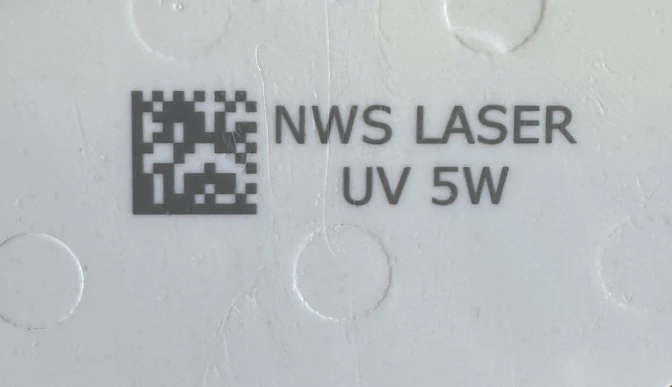
Identify composite plastic parts across a wide range of colours. This application uses IK-SERIES UV to produce traceability markings, with contrast to be validated for each colour.
A single family of composite plastic parts can be offered in many colours. The traceability requirement remains the same: apply a 2D code and a textual identifier on the part without restricting the range to a single colour. The photograph shows the result on a light-coloured composite.
UV laser is the chosen technology for this application with IK-SERIES UV. Pigments, fillers and surface finish can alter the composite’s response to the laser. Settings must therefore be qualified on the references actually produced, with contrast and readability checks for each colour.
A PROCESS TO BE QUALIFIED ACROSS THE RANGE
Prepare representative samples of each reference: colour, composite formulation and surface finish. The contrast obtained on the photographed light part does not predict the result on other colours.
Qualify the UV laser parameters for each reference to achieve the desired marking while controlling surface appearance. Testing will determine whether a common recipe is sufficient or if distinct settings are required.
Check text contrast and code readability with the actual system to be used, under the expected line conditions. Code dimensions, the data to encode and acceptance criteria must be defined before testing.
On a drawing or an annotated photograph, indicate the proposed face, the available dimensions and the desired reading direction. Also locate neighbouring elements: an edge, a raised feature, an opening or another inscription. If several locations are possible, identify a preferred area and the alternatives to be examined rather than leaving this choice implicit.
At which stage must the code be read: on the part alone, after assembly or during a subsequent inspection? Will the area remain accessible in that configuration? Specify the positioning constraints to be discussed during the study, without assuming their feasibility.
Include an exact example of the expected data, distinguishing fixed information from variable information. Describe what each field represents: a part reference, batch or individual identifier, according to your requirements. Indicate the separators, spaces and characters to be preserved, as well as the proposed maximum length.
Should the visible text repeat all the content of the code or only certain fields? Prepare a layout that distinguishes these two forms of reading and identify its version. If the data come from a file, specify its structure and how a row must be associated with a part; these arrangements remain to be agreed.
Before the trials, agree on the checks that will determine whether a proposal is accepted or reviewed. Reading the code and visually assessing the text answer different questions: what data must be returned and what appearance is acceptable? Do not adopt an assessment such as “legible marking” without describing the associated inspection.
Assign an identifier to the parts proposed for the trials and associate each one with its documentary reference. Report information that is still unknown and variants that are unavailable, in order to define the scope to be examined.
The IK-SERIES UV product sheet puts the equipment mentioned on this page in context. The guide to laser marking engineering plastics adds to the preparation of material questions. Bring together your annotations, layout and criteria to prepare your application study request.
YOUR APPLICATION
Send us your composite references, the colours to be marked, the code content and your reading conditions. We will assess the UV process suited to your parts range.