Pulse duration
The seed allows pulses from a few nanoseconds to several hundred ns at a constant repetition rate. You can select the regime (ablation, superficial fusion, annealing) without changing the source.

NWS Laser EXPERTISE · FIBER MOPA
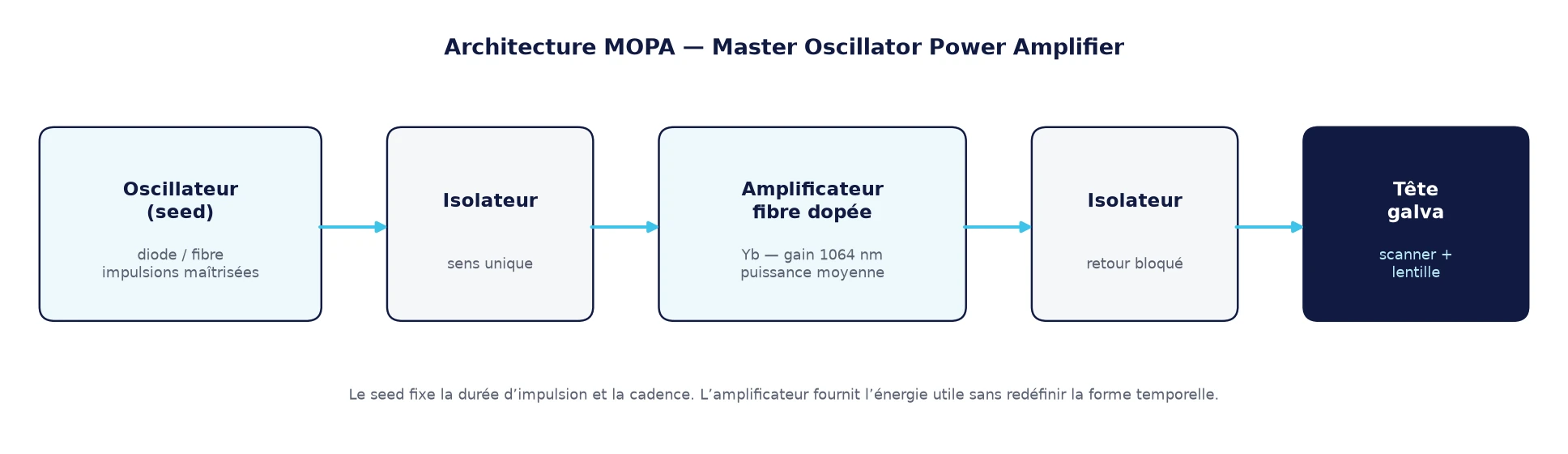
A MOPA fiber laser (Master Oscillator Power Amplifier) separates pulse generation from amplification. This lets you select pulse duration, repetition rate and usable energy as independent settings — something a conventional fiber Q-switch doesn’t truly allow.
DEFINITION
The master oscillator (seed) generates a short, defined pulse. The amplifier, an ytterbium-doped fiber pumped by diodes, raises the energy without reshaping the temporal profile. Isolators between them prevent back-reflections from damaging the seed. At the output: 1064 nm, galvanometric head, field lens. It is this separation that makes MOPA useful on the shop floor, not a “more power” slogan.
WHY MOPA
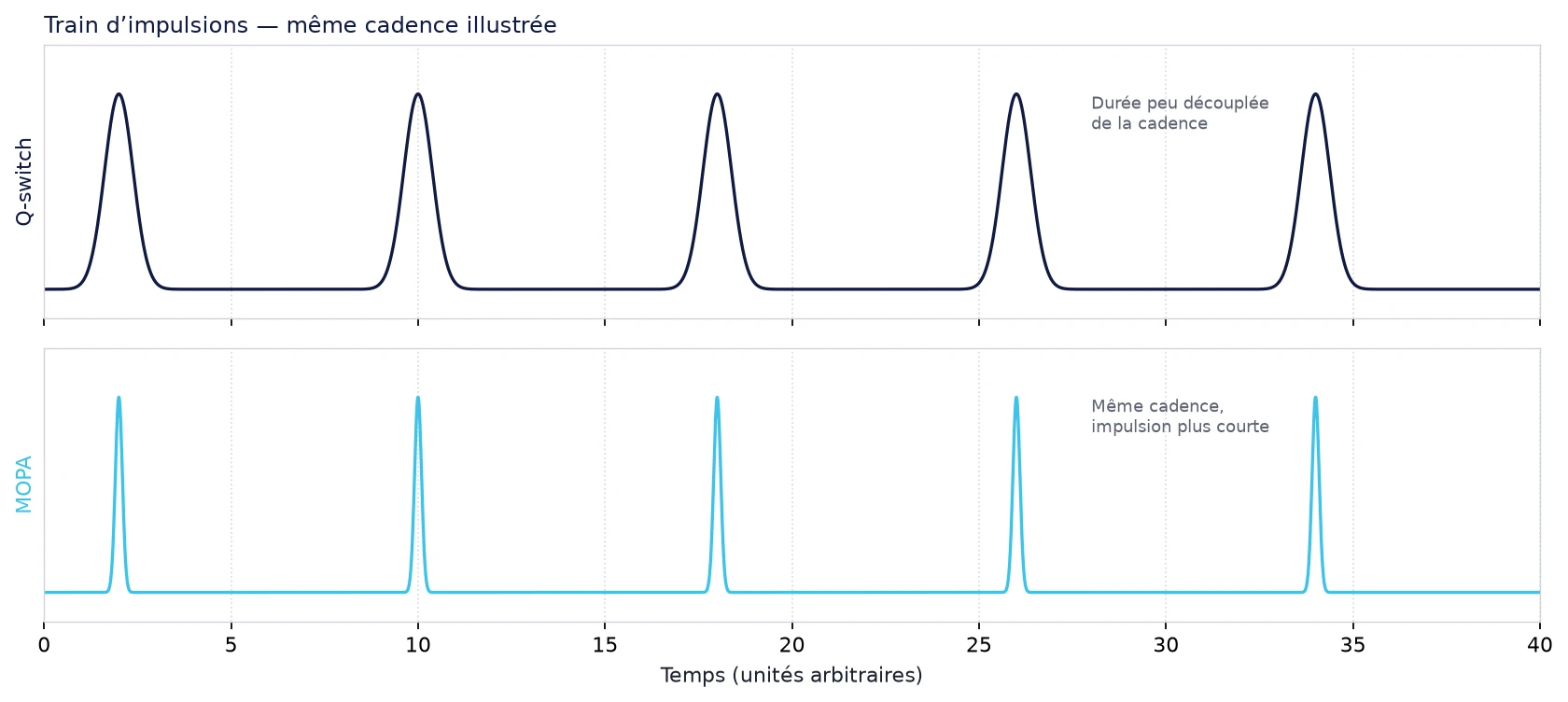
In a Q-switched fiber the cavity and saturable absorber define an operating window. Increasing repetition frequency often lengthens the pulse and reduces peak power. Contrast on plastics, steel annealing or a dense DataMatrix can no longer be tuned independently.
The seed allows pulses from a few nanoseconds to several hundred ns at a constant repetition rate. You can select the regime (ablation, superficial fusion, annealing) without changing the source.
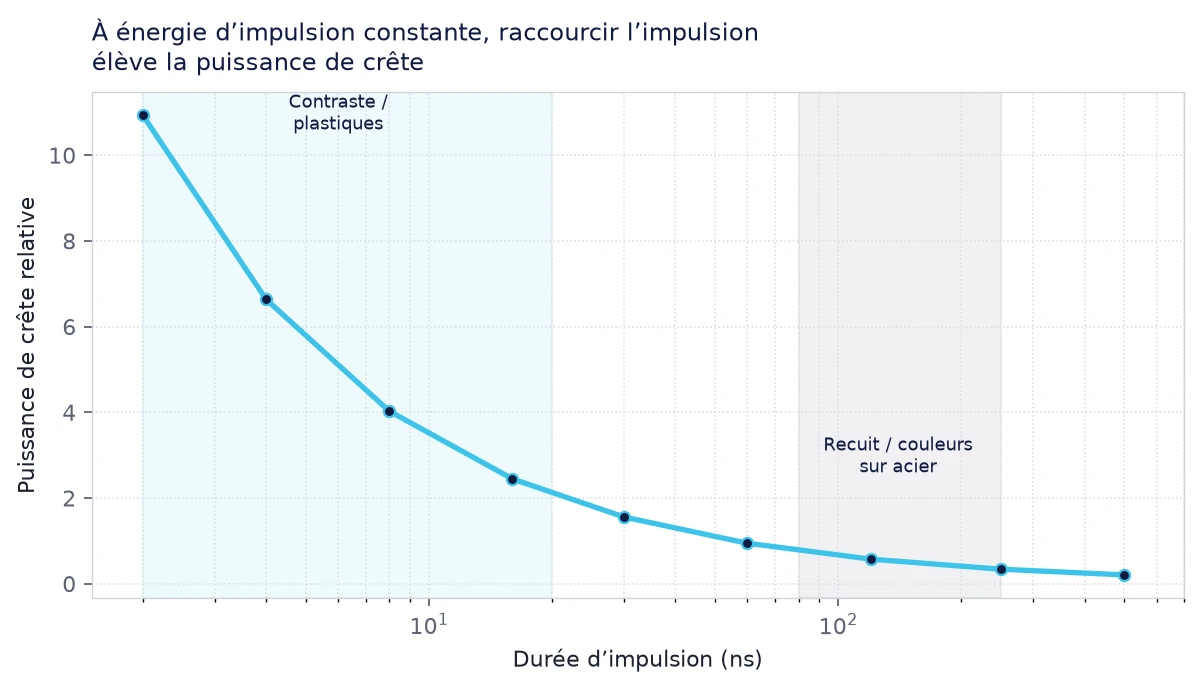
At a given pulse energy, shortening the pulse raises the peak. That is what yields higher contrast on some plastics and crisp metal marking without large thermal input.
You can go into the kHz range for a DataMatrix or line-rate operation while keeping a short pulse. A conventional Q-switch often forces a compromise.
USEFUL PARAMETERS
SHOP FLOOR MAGNITUDES
Exact values must be qualified on the material / surface condition pair. Annealed steel is not comparable to glass‑filled POM, even at 1064 nm.
ON THE PART
1064 nm remains a near‑infrared laser: it heats and couples well to most metals, less so to some transparents. The MOPA advantage is the adjustment window, not a wavelength miracle.
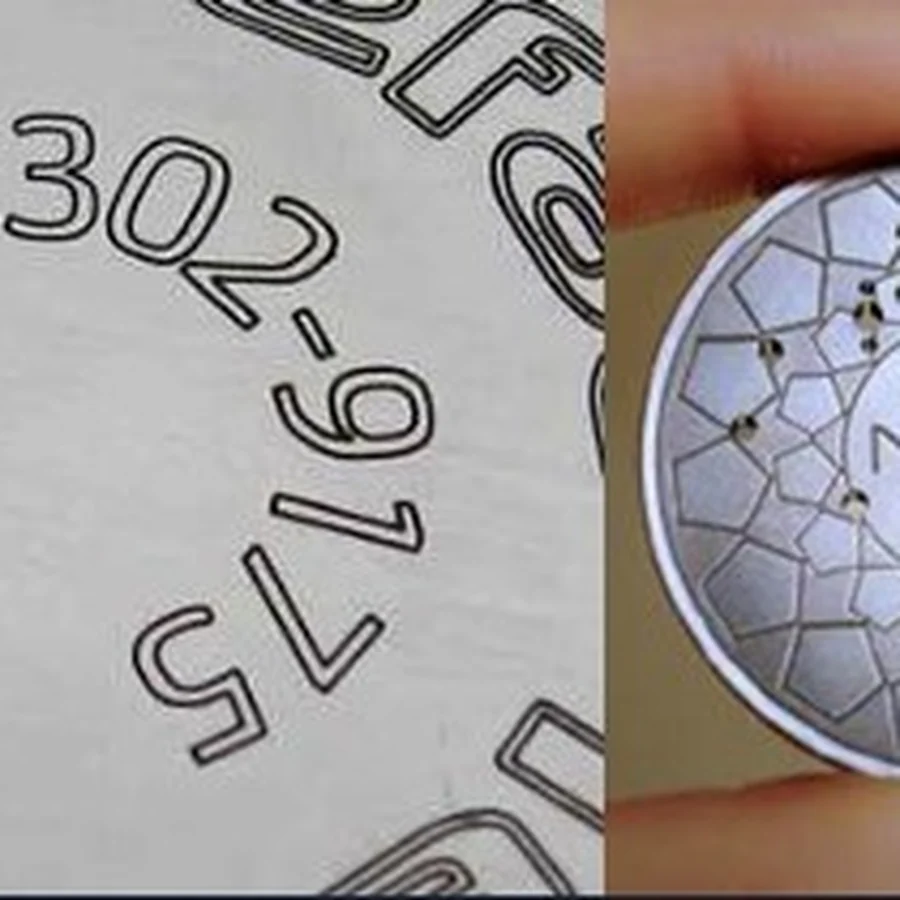
Engraving, controlled oxidation, annealing. On stainless steel, a longer pulse and an adapted repetition rate can produce a dark contrast or interference colors. On aluminium, the aim is usually a light contrast by modifying roughness.
A high peak, short pulse limits polymer melting and favors blackening or whitening depending on additives (carbon black, TiO2 ). Validate on the actual grade: an ABS is not a PEEK.
DataMatrix, QR, serial numbers. High repetition rate helps fill a dense matrix without lengthening the pulse. Readability (grade, contrast, module) should be checked with the same workshop lighting.
CHOICE GUIDELINES
NWS LASER MACHINES
INTEGRABLE
MOPA fibre source in an all‑in‑one enclosure, 24 Vdc, 8‑hole M6 mounting plate. For a cell, a robot or a line: the laser is integrated, a PC is not mandatory in production.
See the IK-SERIES datasheetMARKING STATION
Class 1 enclosure, electric door, galvo head on Z axis, Smart Vision. The MOPA source finds a workshop station there when the part comes to the machine, not vice versa.
See the IK-BOX datasheetWORKSHOP QUESTIONS
TEST ON PART
Specify alloy or compound, surface condition, target code or logo, cycle rate. NWS Laser offers a MOPA trial on IK-SERIES or IK-BOX rather than a catalogue promise.