The data
Reference, lot, serial number or other variable information: the exact content affects the symbol size. In a GS1 context, FNC1 and any separators are also part of the encoding.

NWS LASER RESOURCES · GUIDE · COPPER & BUSBAR
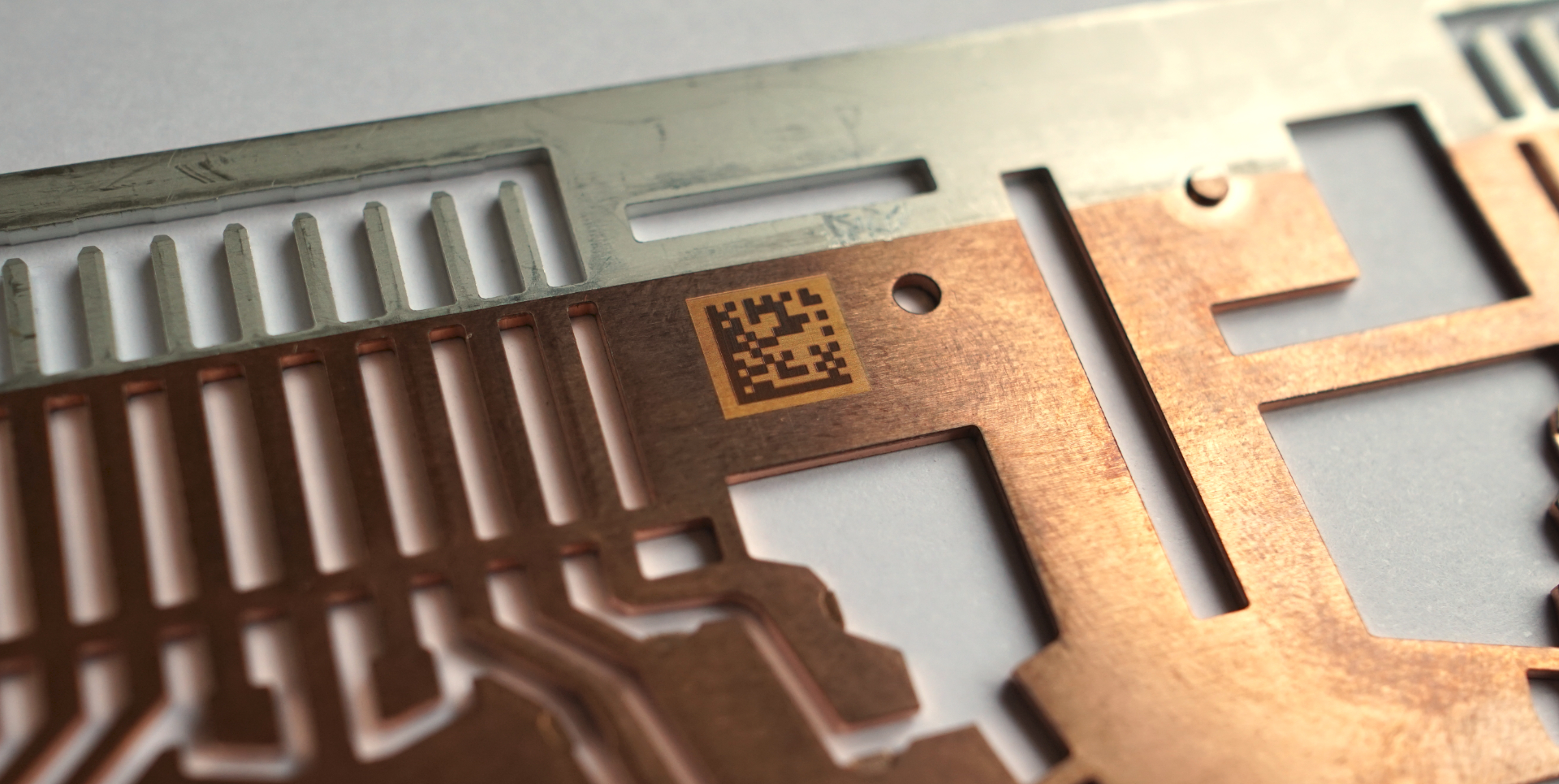
A DataMatrix on copper or a busbar cannot be assessed by appearance alone. The part, data, area, module, reader and inspection must all be considered as part of the same traceability project.
01 · THE PART BEFORE THE SETTINGS
Reflectivity, finish, oxidation, cleanliness, coating, flatness and proximity to the code area can affect the result that is useful to the reader. On a busbar, the functional area and integration constraints are also part of the study.
The aim, therefore, is not to reproduce a generic setting. It is to obtain a code suited to the part, the reading workflow and the acceptance level defined for the project.
02 · THE FOUR KEY POINTS
Reference, lot, serial number or other variable information: the exact content affects the symbol size. In a GS1 context, FNC1 and any separators are also part of the encoding.
The available area includes the symbol, its clear perimeter and the clearances needed from edges, raised features or other markings. A quiet zone of 1 module on each side is the GS1 guideline.
The source, pulse shape, focusing, scanning, part fixturing and surface condition should be studied for the desired result, without considering them separately from readability.
The reader or camera, lighting, distance, angle and operating cycle must be known before concluding that a code is suitable for production.
PREPARATION METHOD
This table does not replace a test plan. It helps prepare the information needed to decide what to test on a representative part.
Two copper parts described identically can behave differently depending on their grade, finish, lot or reading environment. The test remains the deciding point.
03 · SIZING WITHOUT OVERINTERPRETING
A symbol's size depends on the exact data and its encoding. The GS1 DataMatrix guide states that the quiet zone is a clear area around the code, with a width equal to one X-dimension on all four sides.
The area to be reserved must therefore include the symbol and its perimeter. It must also be compatible with the part geometry, nearby edges, raised features and reading device.
Size a DataMatrix before testing on copper
Pre-size the areaGS1 GUIDELINE
1XThe final size cannot be confirmed based on character count alone. The exact content, data format and reading system remain decisive.
Consult the GS1 DataMatrix guide04 · READING IS NOT VERIFICATION
Can a reader retrieve the expected data in a given configuration? This is useful information, but on its own it does not describe the marking's robustness margin.
The DPM quality method must be defined in accordance with the specification. ISO/IEC 29158:2025 addresses lighting conditions, measurement parameters and the reporting of results for direct part marks.
Part position, presentation to the reader, throughput, nonconforming parts and the actual environment all influence the production decision.
ISO/IEC 29158:2025 provides a methodological framework for DPM quality; it does not, on its own, define the grade required for each application. See the ISO/IEC 29158:2025 guide Organize DataMatrix reading in production
TEST PROTOCOL
Representative part or sample, material and finish, marking-area drawing, data content, throughput and intended reading method.
Document the result relevant to the reader and the surface constraints, rather than considering appearance alone.
Test under lighting, distance, angle, positioning and operating-rate conditions close to those in production.
Formalize the acceptance criteria, handling of deviations and conditions to be maintained at the workstation or on the line.
FREQUENTLY ASKED QUESTIONS
DATAMATRIX STUDY ON COPPER
Provide the material, finish, marking-area drawing, content to be encoded, throughput and intended reading method. NWS LASER will prepare a process study on a representative part.