Characterize the residues
The nature of the quenching residues, presence of oil and their distribution guide the trials. The area to treat and the expected cleanliness level are defined before tuning.
SURFACE PREPARATION · LASER STRIPPING
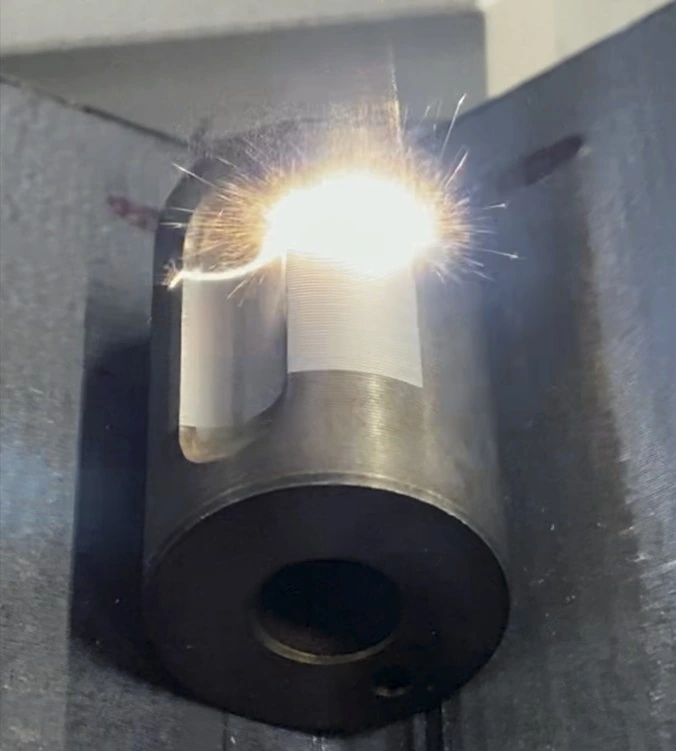
Remove quenching residues and oil from a steel part with a MOPA 100 W laser.
This application covers a steel part contaminated with quenching residues and oil. Laser stripping targets the area to be cleaned to prepare the surface for the next operation.
The process uses a MOPA 100 W laser source. Pulse settings, scanning and pass strategy are developed on the real part. The aim is to remove residues while meeting the required surface criteria for the steel.
RESIDUES, SURFACE, WORKSTATION
The nature of the quenching residues, presence of oil and their distribution guide the trials. The area to treat and the expected cleanliness level are defined before tuning.
The MOPA 100 W source enables pulse parameter tuning. Scanning and number of passes are set according to present residues. Results are checked on the actual surface, not only by visual appearance.
Fumes, particles, spatter and fire risk from oily residues are part of the assessment. Laser enclosure and appropriate extraction must be provided with the process.
To prepare the trial, identify the part reference and the batch it comes from. Specify at what point in the manufacturing sequence it will be presented to the laser: after quenching, after storage or after preparation has already been carried out. Report any prior cleaning so that this condition can be distinguished from the condition normally encountered in the workshop.
If the parts have different appearances, describe those differences rather than selecting only the cleanest part. Which oil is used? Are the observed residues usual or exceptional? Missing information remains to be clarified with the people responsible for the treatment.
On an identified photograph or drawing, indicate the relevant face, the boundaries of the area to be stripped and the surfaces to be excluded. Add a reference point that allows this orientation to be found on the actual part. If several areas are being considered, give each one a name to be used in the discussions.
Specify the document version and the relevant dimensions available. Should the contours follow a functional boundary or a drawn boundary? How will the part be presented and held? These points need to be agreed before several trials are compared.
Prepare a checklist shared by production and inspection, without assuming the outcome. Identify who will decide on acceptance and by which method. A photograph can document the observed appearance, but the file must specify what it will actually allow you to assess.
Bring together the part reference points, the annotated documents and the proposed criteria to submit your technical application. Distinguish confirmed information from open questions, particularly those concerning the oil and the presentation conditions.
If you have identified equipment in the machine catalogue, mention that reference as an option to be studied, without assuming its suitability. To prepare workshop questions, consult the study points on fire risk and extraction: the arrangements specific to your station remain to be agreed.
APPLICATION STUDY
Provide the steel grade, residue type, area to clean and expected surface condition. The NWS Laser team prepares a stripping trial and studies integration conditions.