Cutting process
Sparks, splashes and incandescent particles generated at the source.
NWS LASER EXPERTISE · FIRE PREVENTION
Laser cutting, engraving and machining: understand how incandescent particles can turn an extraction system into a fire hazard, then choose the appropriate control barriers.
THE ACTUAL RISK
In a cutting-fume extraction system, the airflow can carry hot particles into ducts, collection trays and filter media. The risk is not limited to the machine: it develops across the entire chain, from the cut point to the final filtration.
THE FIRE TRIANGLE
An ignition source — spark, incandescent projection or smoldering particle — can be carried by the extraction airflow. Air supplies the oxidizer; dusts, oils, coatings or deposits can form the fuel. Prevention means interrupting this chain before contact with the most vulnerable areas.
The mechanism is documented by Lincoln Electric for fume extraction systems, and the concept of combustible dusts is addressed by OSHA and INRS. [2] [3] [4]
CONTROL CHAIN
The correct location for the prevention barrier is upstream of elements where combustible deposits and heavy filter loading can accumulate.
Sparks, splashes and incandescent particles generated at the source.
Air, ducts and extraction velocity carry particles toward the filtration unit.
Filters, deposits, collection tray and dust collector concentrate the sensitive elements.
Particle separation, thermal detection, maintenance and appropriate protections.
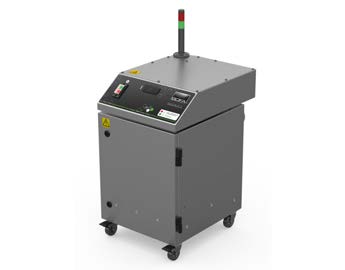
The Spark Arrestor 2 is presented by Donaldson BOFA as a spark-reduction and thermal-cutoff barrier for the flow; it complements the hazard analysis of the installation, without replacing it. [6] [9]
FIRE, DEFLAGRATION, EXPLOSION
A fire requires a fuel, oxygen and an ignition source. Deflagration further requires combustible dust dispersed in air at an appropriate concentration; an explosion adds confinement, for example in a duct or dust collector. [4]
A hot particle contacts a deposit or combustible medium: it can create a hot spot, smoldering or a fire start.
Combustible dusts dispersed in air become a distinct hazard: combustion rate and pressure can then increase rapidly.
When the preceding conditions occur within a confined volume, the risk must be assessed with appropriate prevention and protection measures.
CONTEXT DATA
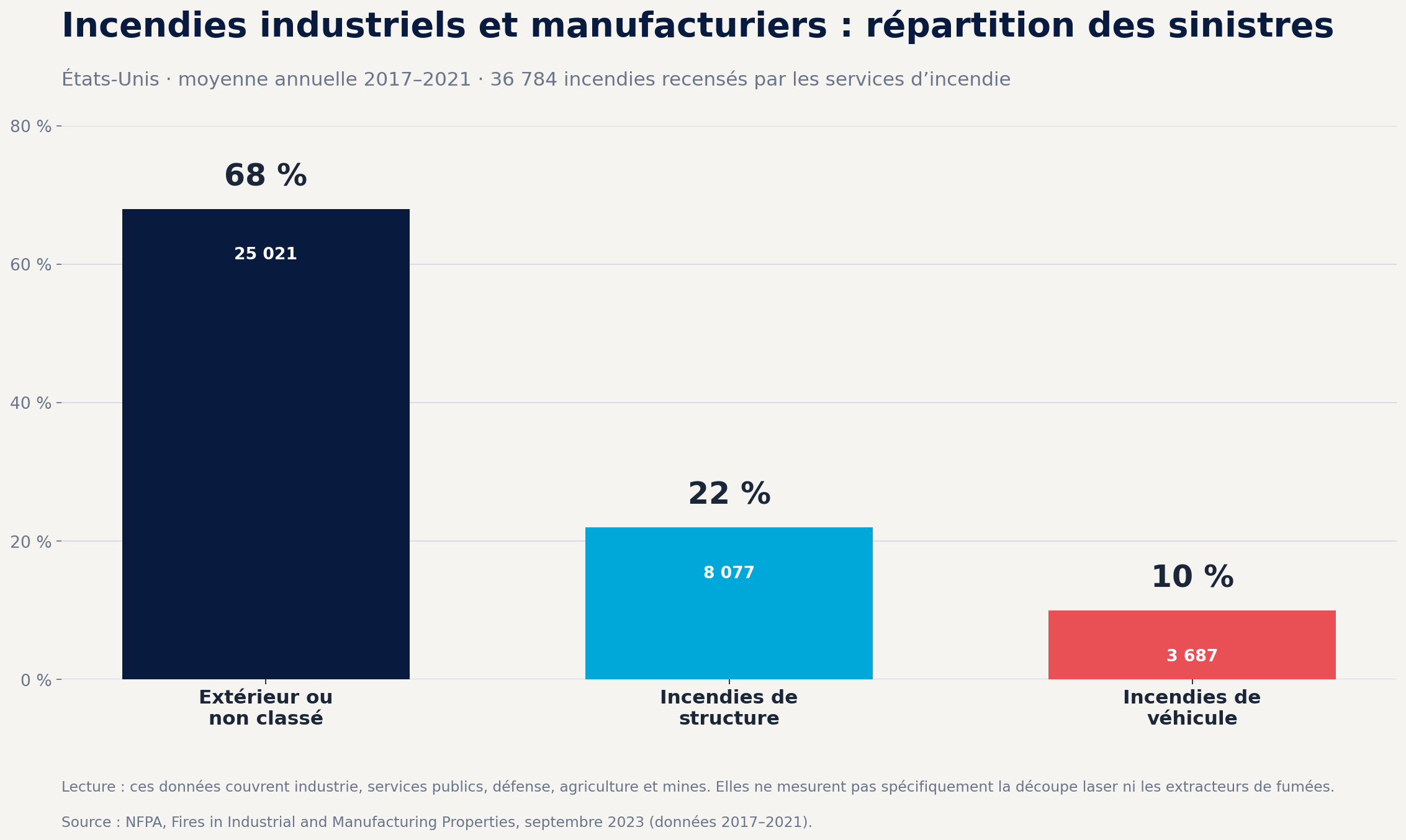
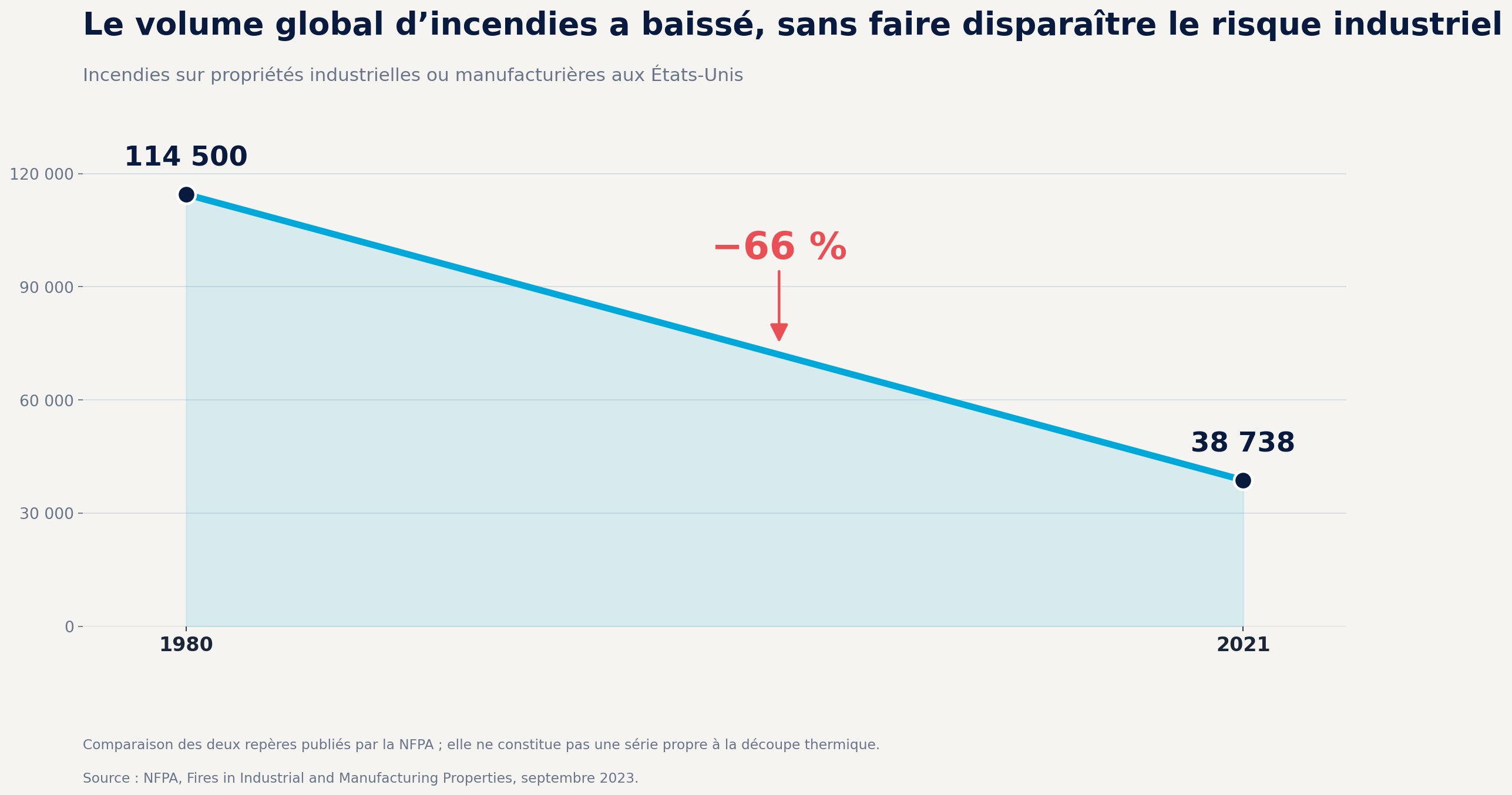
Public statistics do not allow isolating laser cutting or fume extractors alone. However they provide an order of magnitude for fires at industrial and manufacturing sites. The NFPA estimates an annual average of 36,784 fires in this scope in the United States between 2017 and 2021. [1]
Do not extrapolate this as a workshop fire rate: the scope also includes utilities, defense, agriculture and mining.
SCENARIOS TO QUALIFY
The term “laser cutting” is never sufficient to size a protection. Material, coating, throughput, power, capture, ductwork and collection method must be studied together.
UPSTREAM BARRIER · DONALDSON BOFA
The Spark Arrestor 2 is a spark-reduction system intended for laser processes. According to Donaldson BOFA documentation, hot particles pass through impact plates then settle into a removable recovery tray to prevent them reaching the main extractor. [6] [9]
The current product page indicates that a temperature rise of 10°C above ambient triggers an alert and shuts down the extractor. This function should be considered a complementary barrier, to be validated within the process stop logic and workshop intervention procedures. [6]
Coding, marking, cutting, welding, machining and engraving as specified by the manufacturer.
Particle deceleration followed by collection in a recovery tray.
Alert and shutdown of the extraction announced on the Donaldson BOFA product page.
Pre-integration data to be confirmed according to actual network and flow rates.
DEEP PREVENTION
A spark arrestor does not replace risk analysis, the selection of permitted materials, maintenance, operator monitoring, or the fire and explosion protections required for the installation.
Stabilize the process, identify materials, and avoid cutting conditions that produce uncontrolled thermal loading.
Separate glowing particles before the main extractor and sensitive deposition areas.
Test the alarm–shutdown–operator notification chain, and define response procedures.
Document inspections of ducts, trays, and filters; reduce fuel accumulation.
Define additional protective measures when the risk assessment requires them.
FRANCE · EUROPEAN UNION · SWITZERLAND
In France and in the European Union, an explosion risk analysis must be carried out when an explosive atmosphere is likely to form; priority should be given to preventing its formation where possible. In Switzerland, Suva notes that fine dusts can form an explosive atmosphere without this being readily perceptible. [7] [8]
No ATEX conclusion, fire compliance determination, or material compatibility assessment can be drawn from the presence of a Spark Arrestor 2 alone. It depends on the complete installation, the actual material, the dust, and the process.
SOURCES & LIMITS
The specifications and experiential feedback attributed to Donaldson BOFA in this document are manufacturer statements. NFPA, OSHA, INRS and Suva data are used for general context; they do not constitute a site-specific safety qualification.
FIRE PREVENTION STUDY
Present your materials, laser power, cycle rate, extraction network and any incidents. NWS Laser will assess with you the Donaldson BOFA solution suited to your installation.