Prepare the area
Stripping is performed before marking the code to improve readability. The prepared area and target surface condition are defined on the actual part, taking its functional constraints into account.

AUTOMOTIVE · SURFACE PREPARATION
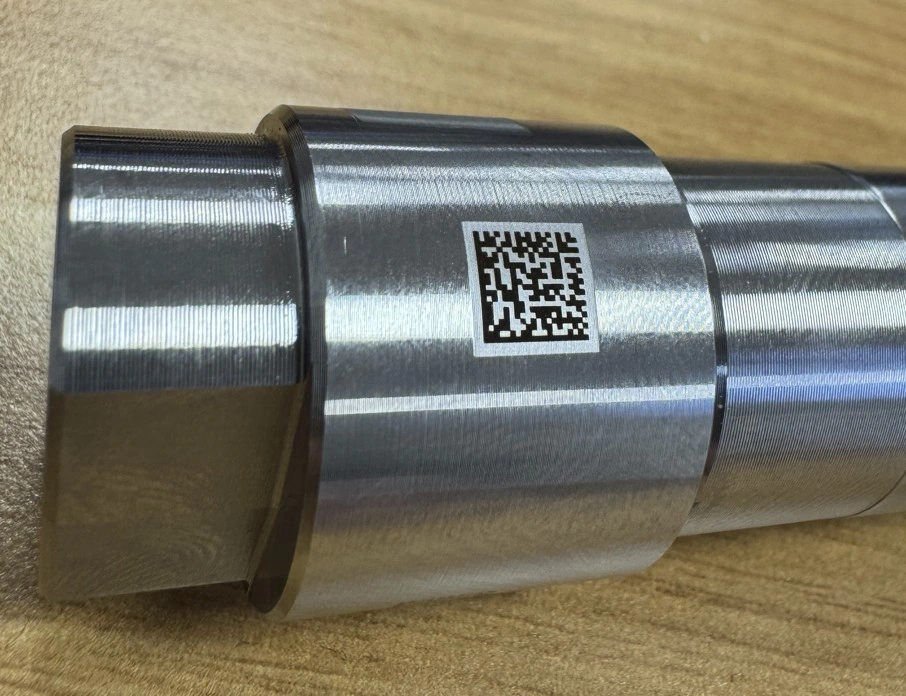
Surface preparation before DataMatrix marking to improve readability on an automotive part. MOPA 20 W laser and Grade A code quality.
This automotive application envisages reading the code directly on the part. A prior stripping prepares the area before marking the DataMatrix. The objective is to improve readability by first working on the surface that will receive the code.
Marking is performed with a MOPA 20 W laser source. The resulting code achieves Grade A quality for this application. Surface preparation and marking settings are developed together, then the result is evaluated with appropriate inspection equipment.
PREPARE · MARK · VERIFY
Stripping is performed before marking the code to improve readability. The prepared area and target surface condition are defined on the actual part, taking its functional constraints into account.
Pulse and frequency settings are adjusted to suit the prepared surface. The DataMatrix content, part positioning and reading conditions guide the process tuning.
This implementation achieves Grade A. A quality grade is determined with an inspection device and a defined protocol; a successful read or a photograph alone do not suffice to establish it.
On a drawing or a photograph with reference points, indicate the proposed DataMatrix location and the areas to be preserved. What dimensions are available? Which reference points allow the part to be oriented? What access or holding constraints need to be examined before consulting the machine catalogue?
When selecting the trial parts, describe their condition at the intended time of stripping, rather than only their condition on receipt. Report any known surface differences between the proposed parts. The selection of variants to be tested and the precautions concerning neighbouring surfaces remain to be agreed during the study.
Provide an example of the expected content, distinguishing fixed information from variable data. Specify the field order, any separators and how the data will be transmitted. Who validates the correspondence between the code and the part reference?
Identify the version of the file or instruction used for the trial. If several references are involved, indicate the differences in content to be examined. Also note the space intended for the code, its orientation and any neighbouring inscriptions, without assuming the dimensions that will be selected.
To make use of the trials, agree on the observations to be recorded after stripping and then after marking. The following criteria need to be specified with your quality and production contacts; they are not stated results.
Bring together the area reference points, the part references, the example data and the inspection criteria in a coherent file. Distinguish requirements that have already been validated from choices that are still open. Indicate who can answer questions about the surface, data and inspection.
The expertise in MOPA technology provides context for the process presented here. To prepare your application study, formulate the questions about stripping separately from those about marking: which variants should be compared, which elements should be observed and which criteria should be validated before any decision is made?
APPLICATION STUDY
Provide the material, surface condition, data to encode, throughput and your inspection requirements. The NWS Laser team will prepare a test combining marking and inspection.