Define the code content
The data to encode determines the number of modules. At a fixed size, more modules mean smaller modules. Useful data and reading capabilities must be defined together.

DIRECT TRACEABILITY · MOPA 20 W LASER
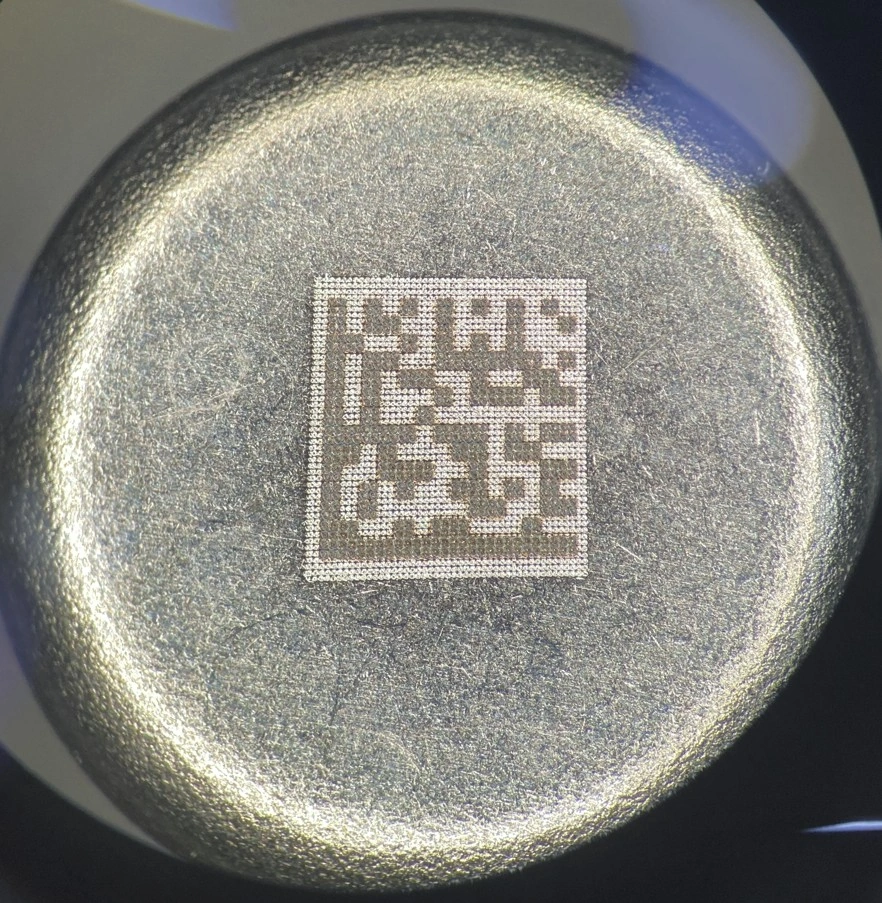
A 2 × 2 mm DataMatrix directly marked on the bottom of a stainless-steel capsule using a MOPA 20 W laser.
This application concerns the marking of a miniature 2 × 2 mm DataMatrix on the bottom of a stainless steel capsule. The code concentrates the information in a reduced area, directly on the part.
Marking is performed with a MOPA 20 W laser source. Pulse duration and repetition rate are adjusted to control the laser–surface interaction. For this miniature format, capsule positioning and module definition require particular care.
A SMALL CODE, VALIDATION REQUIRED
The data to encode determines the number of modules. At a fixed size, more modules mean smaller modules. Useful data and reading capabilities must be defined together.
Fixturing must stabilise the capsule and present its bottom at the correct working distance. MOPA parameters are tuned on the actual part according to stainless-steel finish and desired contrast.
Readability must be verified with the intended camera or reader, its illumination, and the actual part positioning. A photo of the code does not replace validation under production conditions.
On a dimensioned view or an annotated photograph, locate the desired position of the code relative to an identifiable feature of the cap. Specify whether this position is required by your design documentation or remains open to discussion. What margin around the code needs to be allowed in your application? This question needs to be examined during the study, without automatically adopting the arrangement visible on this page.
Also indicate which surfaces can serve as references for presenting the part. Any differences in geometry or finish between the caps proposed for the trials must be reported.
Provide an exact example of the string to be encoded, together with an explanation of its meaning: which information is fixed and which changes from one cap to another? Identify the separators, special characters and any leading zeros that must be preserved. If several types of content are being considered, propose representative examples rather than a single demonstration code.
Distinguish the file used to present the project from the data that will actually need to be read back. Specify who supplies these data and who checks that they match after reading. The working formats and transmission method remain to be agreed with NWS Laser.
Before the trials, define what will determine whether a marked cap is accepted or rejected. Separate the visual assessment of the base, the position of the code and the return of the expected content. For each observation, indicate the criterion being sought and the person responsible for validating it.
To prepare questions about the settings, consult the guidance on MOPA technology, then record the points specific to your part.
Assign a reference to the parts, the annotated views and the data examples. Mention the selected version and the points that are still open: location, variable content, presentation to the reader or acceptance criteria.
In your application study request, distinguish mandatory requirements from preferences. Also indicate who will be able to answer questions about the cap and about reading the code.
APPLICATION STUDY
Provide the part bottom, surface condition, data to encode and reading conditions. The NWS Laser team will prepare a test tailored to your application.