Define the elements to mark
Identify the texts, graphics and 2D codes to reproduce and their placement on the posage. This definition allows preparing trials focused on the expected appearance, without extrapolating to other applications.

BLACK MARKING · UV 5 W LASER
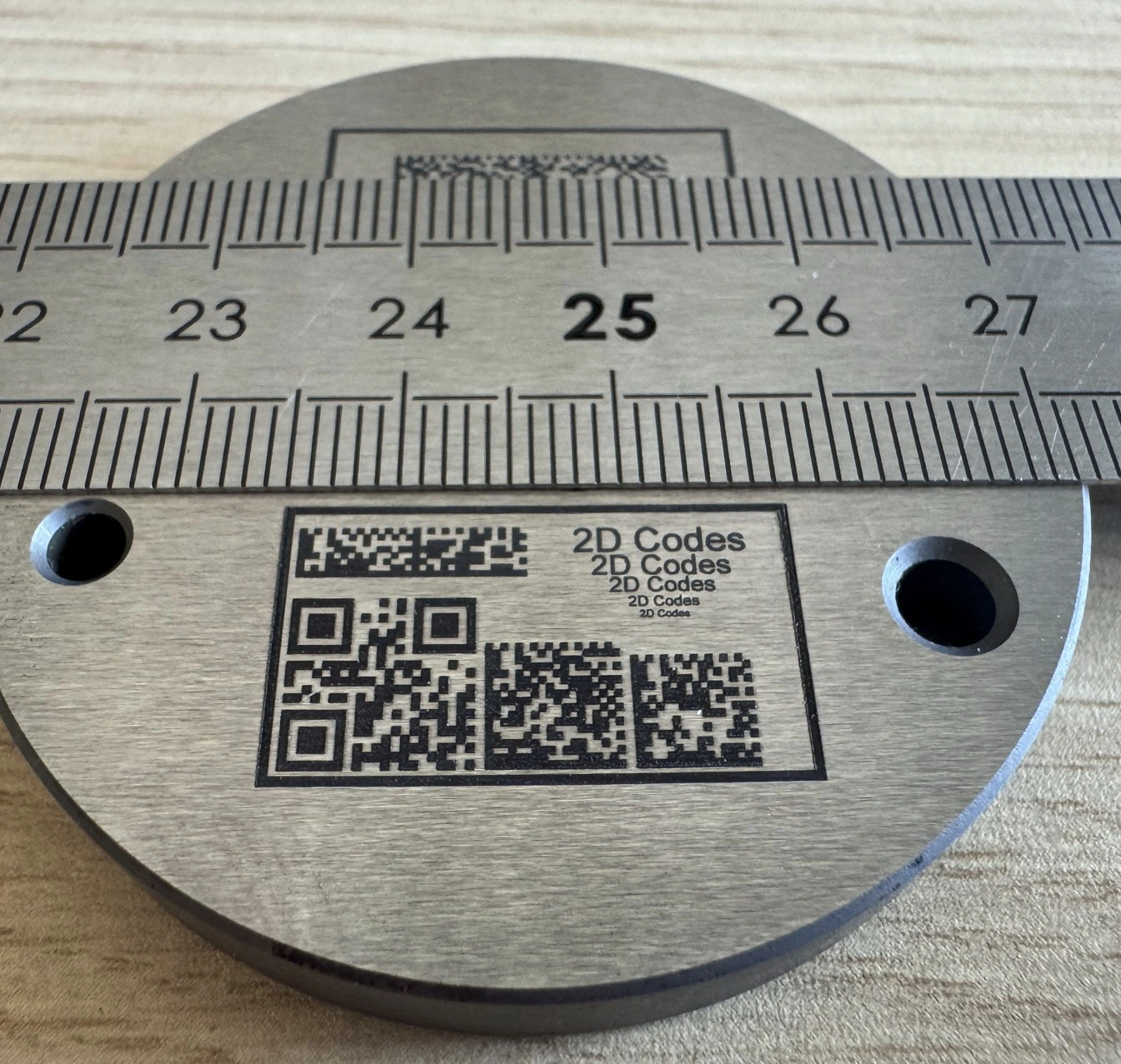
Texts, graphics and 2D codes marked in black on a watchmaking posage, with fine detail and good contrast.
This application covers black marking of texts, graphics and 2D codes directly on a watchmaking posage. The observed result combines fine marking with good contrast to distinguish elements on the posage.
The marking is performed with a UV 5 W laser source. Laser selection and parameter settings are defined from the actual posage and the desired appearance. The results described here correspond to this specific case and must be verified on each support.
FINENESS AND CONTRAST ON POSAGE
Identify the texts, graphics and 2D codes to reproduce and their placement on the posage. This definition allows preparing trials focused on the expected appearance, without extrapolating to other applications.
A UV 5 W laser is used here to achieve black marking with fine detail and good contrast. The final appearance depends on the actual posage and the settings chosen for this application.
Fineness, contrast and legibility must be verified on the specific watchmaking posage. A trial confirms the result on the support and with the planned motifs, texts or 2D codes.
On a view of the fixture, identify the relevant face, the reading direction and the references used to locate the marking. What distances from edges or neighbouring elements must be maintained? Which areas must remain excluded? These details need to be agreed according to the fixture's use, without inferring a placement from the photographed example alone.
Also specify the configuration in which the marking will be viewed: the fixture on its own, with the part in place or another situation to be described. If some elements might be obscured in this configuration, indicate which ones and submit the proposed location to your team for validation.
Distinguish fixed elements from information that will need to change from one fixture to another. For each text element, provide the exact content, desired dimensions and orientation. For a pattern, identify the reference version and report the details whose preservation takes priority. The possibilities for reproduction remain to be examined using the file supplied.
If a 2D code is planned, specify the data to be encoded and the intended reading equipment. Visual reading of the text and reading of the code are two checks to be defined separately; the black appearance of the marking must not be used as the sole acceptance criterion.
Before the trials, agree on the observation conditions and the person responsible for accepting the appearance. Which details must be distinguishable, at what scale and under what lighting? The guidance on the UV laser adds to the technical context, but does not replace these criteria specific to your fixture.
Prepare an inspection checklist, with thresholds or references to be specified for each point:
To prepare your application study, associate the fixture reference, its known surface condition, an annotated view, the marking file and the proposed criteria. Distinguish confirmed information from points that are still open, particularly fixture variants and their differences.
If the project includes equipment, also describe how the fixture is presented and the operations carried out around the marking process. The machine catalogue allows you to review the range; the choice of a configuration remains to be studied, without attributing the results on this page to a model.
APPLICATION STUDY
Provide your watchmaking posage, the elements to mark and the desired appearance. The NWS Laser team will prepare the trial adapted to your application with a UV 5 W laser.