Define the motif
The decoration geometry determines trace width, areas to remove and the sequence of passes. The design must account for the part’s shape and the desired relief.
WATCH DECORATION · INFRARED NAN0SECOND MOPA LASER
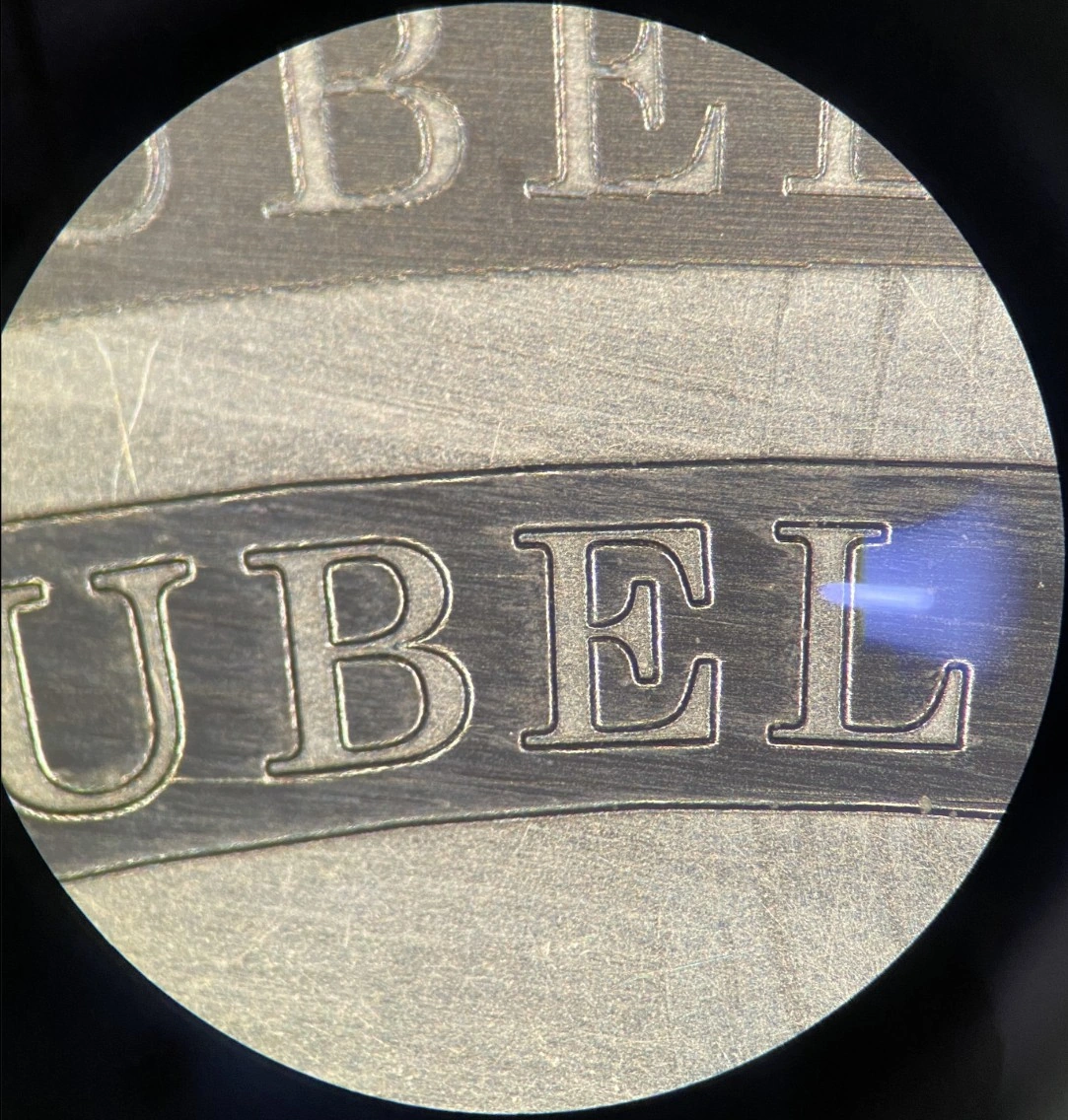
A decorative engraving 500 µm deep executed on a titanium watch component with an IK-SERIES infrared nanosecond MOPA laser.
This application covers the creation of a decorative motif on a titanium watch component. The achieved engraving depth for this job is 500 µm, producing a relief designed to integrate with the part’s geometry and finish.
Material is removed by successive passes to build the motif depth. Trace definition, pass overlap and laser–material interaction settings contribute to control of relief and surface finish. Parameters are validated on the specific part and motif; this 500 µm result is not automatically transferable to all projects.
A DECORATIVE RELIEF TO BUILD
The decoration geometry determines trace width, areas to remove and the sequence of passes. The design must account for the part’s shape and the desired relief.
The laser progressively removes material through successive passes. Overlap and trajectory order are adjusted to achieve the 500 µm depth for this specific execution.
Settings are verified on the actual motif to preserve detail definition and the expected surface appearance. The finish depends on the titanium, geometry and the parameters chosen for the part.
On an annotated view of the part, define the decoration and indicate its orientation relative to the drawing reference points. Identify the neighbouring surfaces to be preserved and the functional areas whose constraints will need to be examined during the study. What distances from the edges and what positioning limits need to be agreed?
Also specify at which manufacturing stage engraving is being considered. Does the part proposed for the trials have the same surface condition as the intended production part? If subsequent finishing is being considered, describe it as a point to be taken into account, without assuming the final result.
Distinguish the drawing used to position the decoration from the file describing the pattern itself. Indicate the scale, units, selected version and priority details. An illustration of the intended design must not leave the boundaries of the areas to be engraved ambiguous: specify what must be recessed and what must remain raised.
If several variants are being considered, name them and designate the one to be examined first. Can details be adjusted after the trials, or is the design fixed? To put the equipment associated with the presented application in context, consult the IK-SERIES product sheet, without inferring a configuration for your own part.
Before the trials, separate aesthetic expectations from measurable requirements. A reference photograph can illustrate the desired appearance, but the observation conditions and inspection points remain to be defined. Technical expertise provides a starting point for framing these questions.
Bring together the references for the drawing, pattern and proposed part. Report information that is still missing, particularly the titanium grade or surface condition if these are not documented. Specify whether the available part is representative or has differences that need to be discussed.
In your application study request, distinguish essential requirements from aesthetic preferences. Add the open questions and identify the person authorised to decide on a change to the decoration.
APPLICATION STUDY
Provide the part, the decorative motif, the target depth and the desired finish. The NWS Laser team will assess the material removal sequence and testing needed for your application.