Prepare traceability
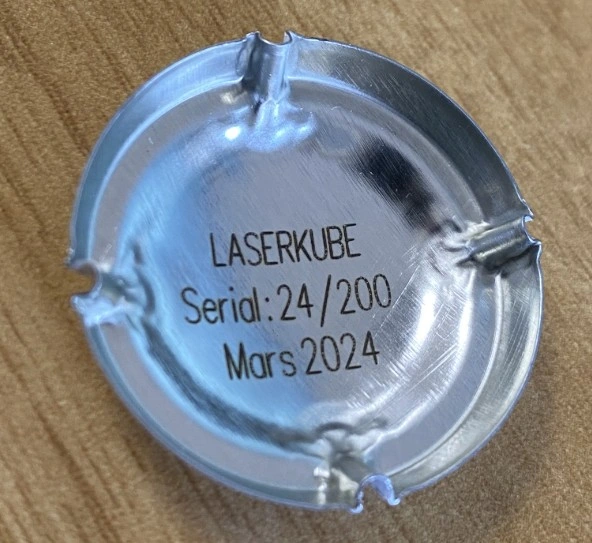
The information to mark on the underside depends on the required traceability. Content and placement are defined according to the capsule’s actual geometry and the intended reading method.

TRACEABILITY · PAINT REMOVAL · FIBRE 20 W
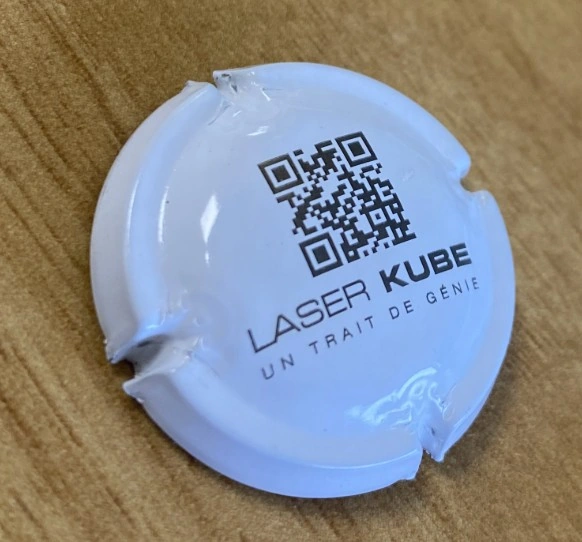
On a champagne bottle stopper capsule, the laser can apply traceability on the underside and remove paint on the upper face to reveal a 2D code and a decorative motif.
This application combines two complementary operations on the same capsule: inscribing traceability information on the underside and performing paint removal on the upper face. The 2D code and motif are produced by the laser work shown in the top view.
The LaserKube-X, equipped with a 20 W fibre laser source, is adjusted according to the capsule’s coating and surface condition. Parameters must be defined on the actual part, and the code must be tested with the reader intended for the application.
TWO OPERATIONS, ONE PART
The information to mark on the underside depends on the required traceability. Content and placement are defined according to the capsule’s actual geometry and the intended reading method.
Paint removal on the top face is configured based on the coating, its surface condition and the contrast required for the 2D code and motif. A trial on the real capsule is used to fine-tune settings.
The code must be read back using the actual reader in its lighting and positioning conditions. The application photo does not constitute full validation of readability.
Prepare a view of each face showing the proposed locations, their dimensions and a common orientation reference point. What space should be reserved for the code, the pattern and the variable information? Indicate the areas to be preserved as they are and any acceptable offsets, to be agreed during the study.
Also specify at which stage the cap would be presented for the operation and for reading. How should its orientation be identified and the two faces distinguished during the trials? These elements need to be examined with the selected part, without inferring a final placement from the application photographs.
In the file, identify the version of the pattern to be reproduced and the version of the content to be encoded. Distinguish fixed elements from fields that change from one cap to another. For each variable field, indicate its meaning, expected length and a representative example, without unnecessary confidential data.
Should the 2D code contain the same information as the text on the underside, only some of it or a different reference? Describe the expected correspondence between the two faces. Also provide an example of the content that the reader will need to return: verification will therefore not concern only the appearance of the code.
Before the trials, agree on the observations that will determine whether each face is accepted or rejected. For the pattern, which details must remain recognisable and what differences in appearance would be acceptable? For traceability, which information must be checked after reading and who will validate that it meets the requirements?
Record the conditions selected for each comparison so that a variation in presentation is not confused with a difference in the result. The following points can structure this preparation:
If several decorations or cap references are involved, describe their differences and specify which ones should be included in the initial scope. Which part represents the usual requirement and which variants need a separate check? Any possibility of reusing a setting remains to be discussed, not assumed.
Bring together this information in your application study request, distinguishing what has already been established from what remains open. Report missing data and decisions that are awaited to prepare for the technical discussion.
APPLICATION STUDY
Provide the capsule, coating, surface condition, traceability data, the 2D code and reading conditions. The NWS Laser team will prepare the test adapted to both uses.